
ID verification
Confirm applicant identity in seconds with automated document checks.
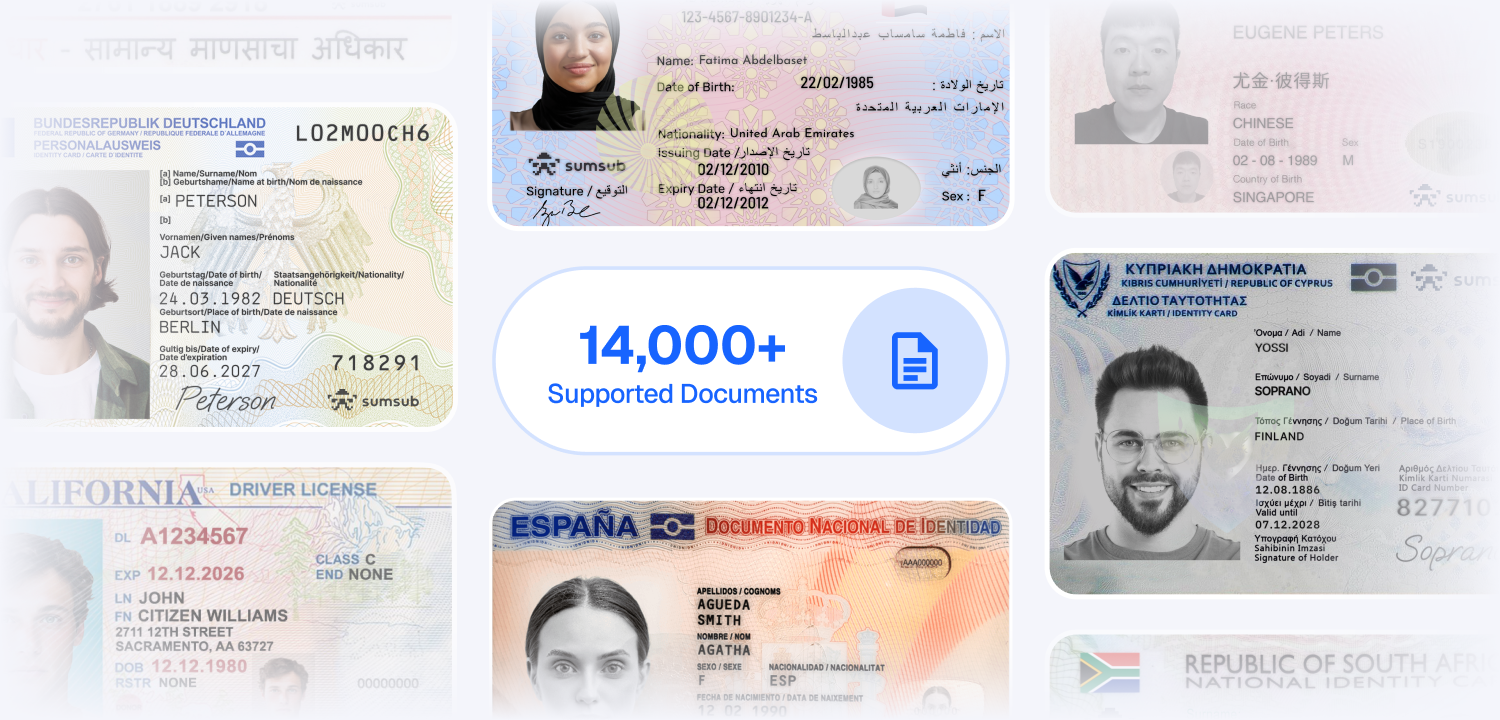
With Sumsub, you can verify users across 220+ countries and territories, with support for 14,000+ ID document types and user flows available in 50+ languages. ID Verification is typically completed using identity documents, along with a range of additional or alternative methods such as trusted data sources, biometrics, NFC chip reading, and video interviews, depending on the market, use case, and regulatory requirements. This helps you build a strong barrier against fraud — including forgery, data tampering, and document manipulation — while keeping conversion rates high.
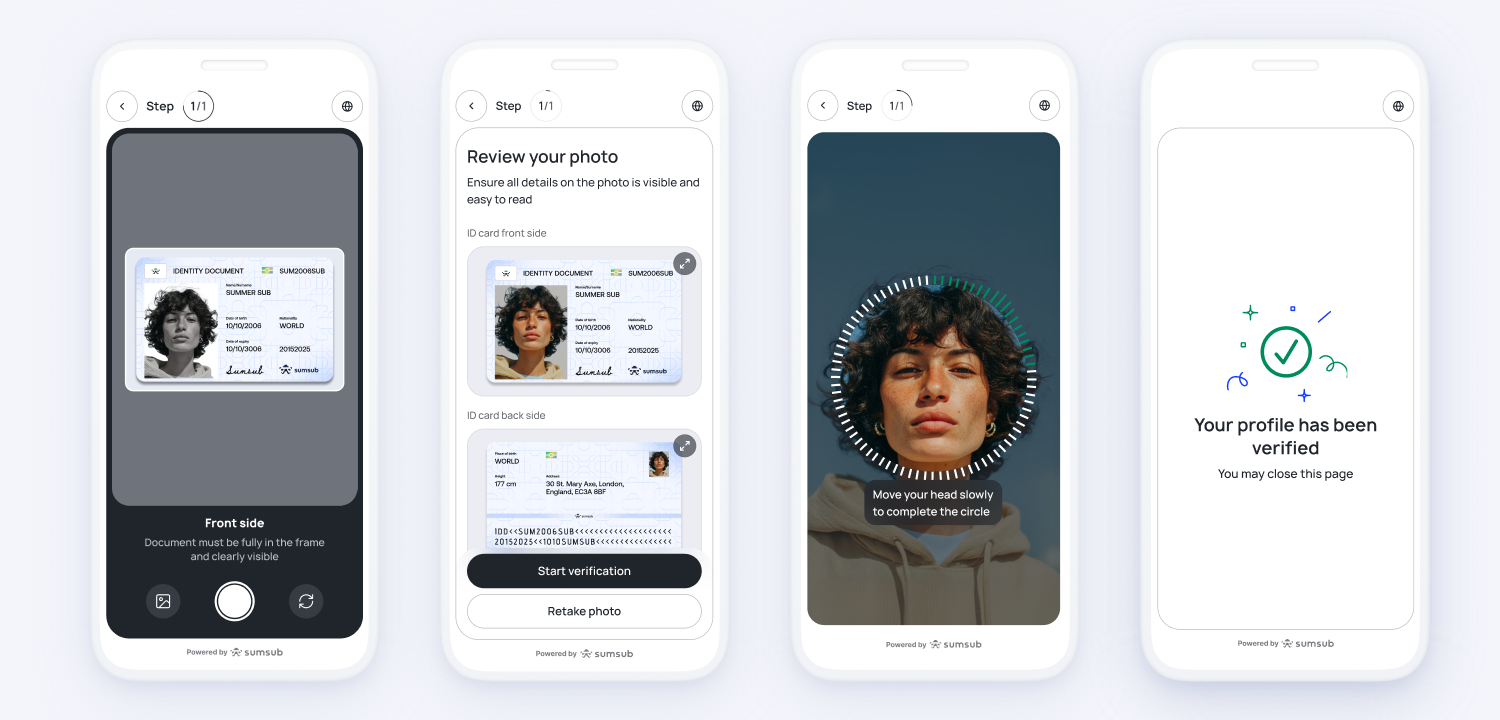
How Sumsub ID verification works
Sumsub ID Verification works as follows:
- Applicant uploads one of 14,000+ supported ID types, which is captured automatically using OCR.
- Sumsub checks the ID for validity and authenticity within 20 seconds.
- If the check passes, the applicant is onboarded. If it fails, the applicant is declined or asked to retry, depending on your setup.
For more information about how Sumsub document-based ID verification works, refer to this article.
ID verification use cases
The following use cases outline which verification method to apply based on your onboarding goals, assurance level, market coverage, and regulatory requirements.
|
Case |
Method |
When to use |
Additional checks |
|---|---|---|---|
|
Standard onboarding |
Use when you need a fast, reliable default flow that works across most markets without added friction. |
||
|
Markets with reliable database coverage |
Non-Doc Verification paired with the document-based ID Verification as a fallback option |
Use when trusted data sources are available, letting you verify quickly and easily, falling back to a document-based flow where coverage is limited. |
|
|
High-assurance flows where documents are required |
Use when documentary proof and stronger assurance are required. |
||
|
Highly regulated or regional flows |
Document-based ID Verification + additional regulated methods |
Use when local regulation or market requirements call for stronger or region-specific identity checks. |
Video identification, NFC-based ID verification, Real-time Identification Recording |
Get started with ID verification
Additional verification methods
Sumsub offers the following methods, which can complement ID verification or serve as an alternative to it:
- Non-Doc Verification — verifies users without requesting documents by checking identity data against trusted databases.
- Database Validation — validates identity data against governmental or commercial databases and can support document-based or non-document flows.
- Biometric Verification — verifies that the applicant is a real person and matches the identity being checked using Liveness and Face Match.
- NFC Verification — reads data from NFC chips in supported identity documents for stronger document and identity assurance.
- German eID Verification — verifies German users through the German electronic identity system.
- Real-time Identification Recording — captures a real-time recording of the applicant during identity verification where required.
- Video identification — verifies applicants through a live video session with an operator, often used for regulated or high-assurance flows.
- Qualified Electronic Signature (QES) Verification — combines identity verification with legally valid electronic signing where required.
Updated about 1 month ago