
Sumsub ID Connect

Streamline privacy-preserving identity verification using Sumsub ID Connect.

Sumsub ID Connect allows businesses to access verified claims, such as age, name, and nationality, from a network of pre-verified identities, while reducing verification costs and ensuring the absolute privacy of the end-user.

Integration with Sumsub ID Connect requires minimal effort and avoids any collection or storage of users’ highly sensitive biometric or source document data by the business. The users store their verification data in a personal Sumsub ID account they are fully in control of, and then give permission to reveal the requested verified identity claims.

How Sumsub ID Connect works

Sumsub ID Connect uses a JavaScript library that follows OIDC (Open ID Connect) standards. With this library, you can add a Verify with Sumsub ID button to any platform, which triggers a Sumsub ID hosted user flow.

During setup, you define OIDC scopes that specify which verified claims (for example, age, name, nationality) your service needs. You can adjust these scopes and other options in the Sumsub dashboard.

When a user clicks Verify with Sumsub ID, your application redirects them to the Sumsub ID Connect flow. The flow checks whether the user already has a Sumsub ID account and whether that account contains enough verified data to satisfy the requested scopes. If necessary, the user completes any missing verification steps. Sumsub hosts and maintains all verification screens, so you do not need to implement or operate these flows yourself.

After the user finishes the flow, the integrating business will receive verified claims as per OIDC protocol standards. This response includes a cryptographically signed JWT (JSON Web Token) that contains the user’s identity claims and can be validated to confirm the token's authenticity and integrity.

If you include the offline_access scope, Sumsub creates an ongoing connection between the user’s Sumsub ID and your service. This connection allows your service to request verified claims again in the future for any scopes the user has already approved, without asking the user to repeat the full flow. The user creates this connection once and can revoke it at any time from their Sumsub ID account.

Existing Sumsub ID account

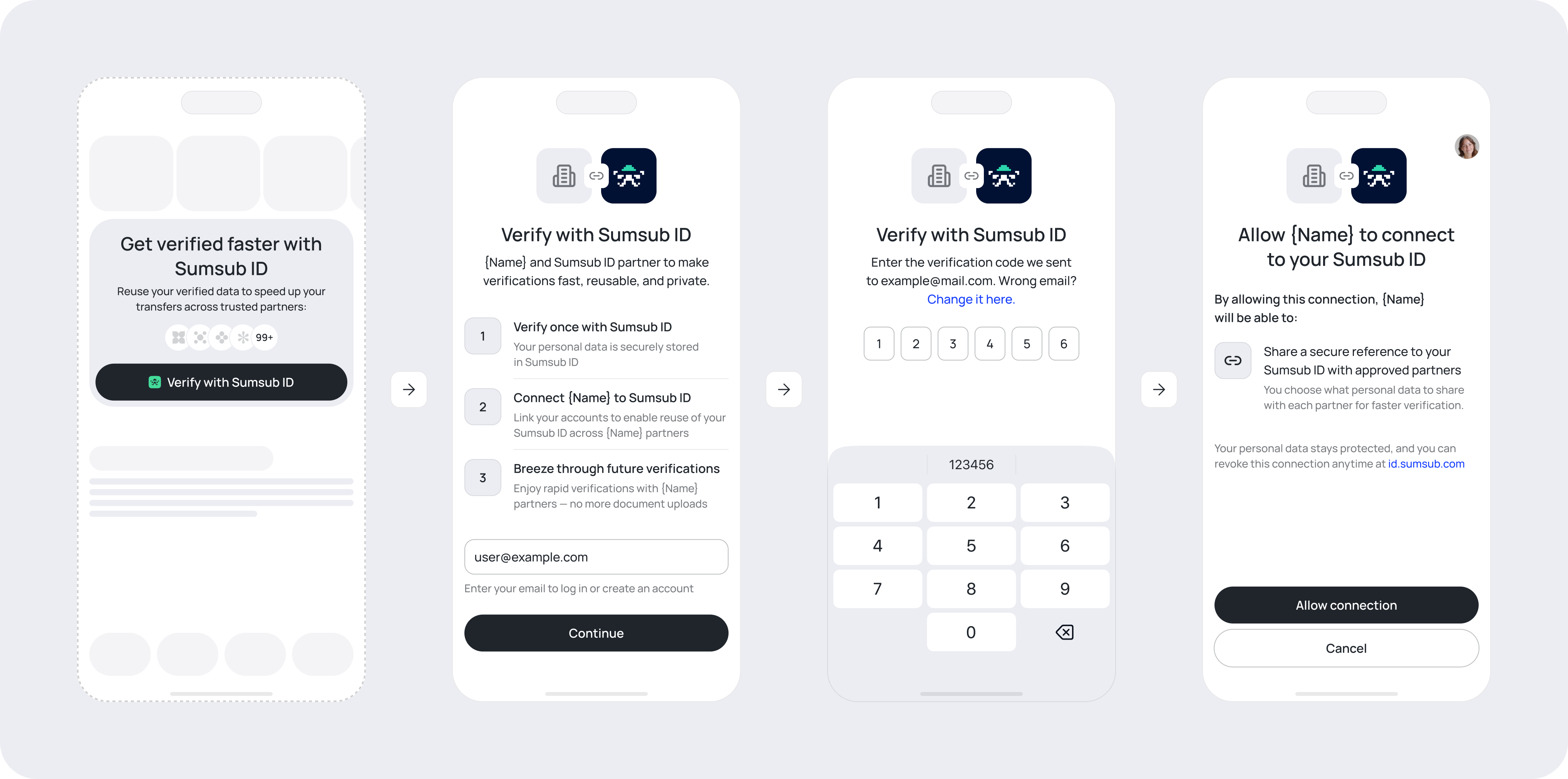
If Sumsub ID already exists and contains requested verified data:

  1. Authentication. User provides and confirms their email address.
  2. Authorisation. User gives permission to reveal certain verified claims to the integrating business.
Non-existing Sumsub ID account

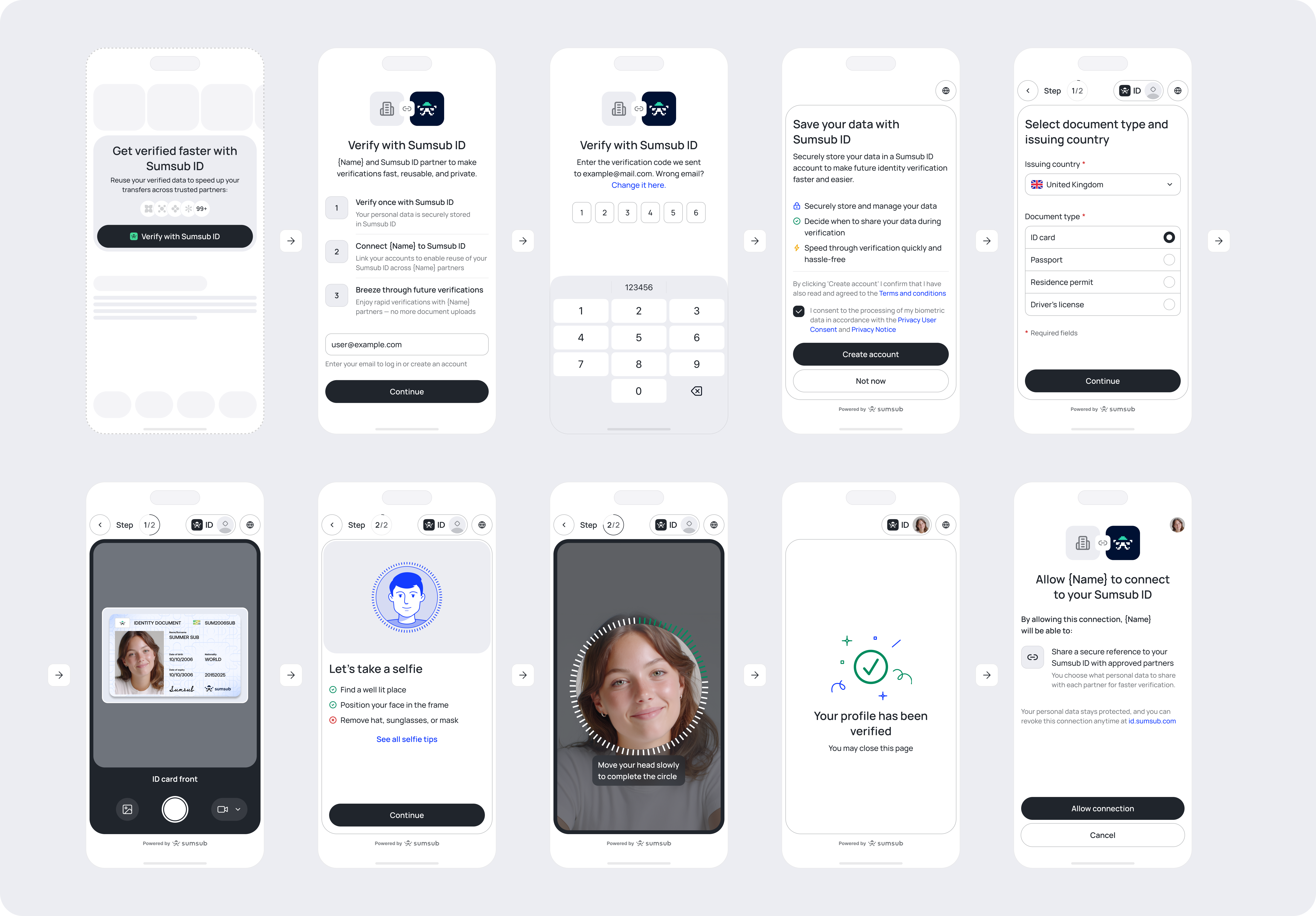
If Sumsub ID does not exist:

  1. Authentication. User provides and confirms their email address.
  2. Sumsub ID account creation. User will be prompted to create a Sumsub ID account.
  3. Verification. Sumsub runs the checks needed to provide the requested data. These checks depend on the scopes you ask for and the steps already completed by the applicant.
  4. Authorisation. User gives permission to reveal certain verified claims to integrating business.
OIDC integration

Sumsub ID supports OpenID Connect (OIDC), which allows you to authenticate verified users using Sumsub ID.

Implementation details

  • Issuer: https://id.sumsub.com/
  • Configuration URL: https://id.sumsub.com/.well-known/openid-configuration

The OpenID Connect discovery protocol allows you to automatically configure OIDC integrations using the metadata provided at the configuration URL.

Configuration metadata

The configuration contains metadata describing:

  • Authorization and token endpoints.
  • Userinfo endpoint.
  • Supported scopes, response types, and grant types.
  • Public keys for ID token validation.

Supported scopes

The following table describes the supported scope values—permissions that grant access to specific actions within Sumsub ID Connect—used in the following request.

ScopeDescription
openidReturns the ID token (id_token). Required by OpenID Connect.
emailGrants access to the user’s email address.
nameGrants access to the user’s name information.
shareGrants permission to generate a Sumsub ID Share token.
offline_accessGrants permission to obtain a refresh_token.

Enable OIDC integration

To enable and use OpenID Connect, complete the following steps in the Dashboard:

  1. Navigate to Reusable IdentitySumsub ID Connect.
  2. Generate a secret key and register a redirect URL.
  3. Save changes.

Verify with Sumsub ID Connect button integration

Use the Sumsub ID Connect JavaScript library to add a Verify with Sumsub ID button and run the authorization flow with OIDC.

The library includes:

  • Secure OAuth 2.0 authentication with Sumsub ID and customizable button
  • Simple API with TypeScript support
  • Responsive behavior across devices
  • Automatic handling of the authorization flow (including PKCE – Proof Key for Code Exchange)

You can install the package using npm, yarn, or pnpm:

npm install @sumsub/id-connect
yarn add @sumsub/id-connect
pnpm add @sumsub/id-connect

How JavaScript library works

The library implements the OAuth 2.0 Authorization Code flow with PKCE:

  1. Your frontend initializes the library with your clientId and optional security parameters.

  2. When the user clicks the button, the library opens a popup where the user authorizes with Sumsub ID.

  3. After a successful authorization, the library calls the onSuccess callback with an authorization code.

  4. Your backend exchanges this authorization code for Sumsub ID Connect token.

    For an OIDC-compliant flow, use the token and userinfo endpoints from the OIDC metadata file:

    Use the client secret key that you configured in the Sumsub ID Connectsection in the Sumsub Dashboard.

  5. Your backend validates the tokens and uses them to retrieve user details and verified claims according to the scopes you requested.

🚧

Attention

  • The authorization code expires quickly, so exchange it for tokens as soon as possible.
  • Add your domain in the Sumsub ID Connect configuration section.

How to integrate JavaScript library

You can integrate the library in two ways:

  1. Use the pre-built button.
    import { createButton } from '@sumsub/id-connect';
    createButton({
      clientId: 'your-client-id',
      permissions: ['share'],
      container: document.getElementById('button-container'),
      onSuccess: (response) => console.log('Authorization successful:', response.code),
      onError: (error) => console.error('Authorization error:', error.message),
      className: 'custom-button-class',
      text: 'Verify with Sumsub ID'
    });
    
  2. Use your own button with the modal.
    import { openModal } from '@sumsub/id-connect';
    document.getElementById('your-custom-button')!.addEventListener('click', () => {
      openModal({
        clientId: 'your-client-id',
        permissions: ['share'],
        onSuccess: (response) => console.log('Authorization successful:', response.code),
        onError: (error) => console.error('Authorization error:', error.message),
        onLoading: (isLoading) => console.log('Loading state:', isLoading)
      });
    });
    

UMD build

You can also include the UMD build (JavaScript bundle formatted using the Universal Module Definition pattern) directly in your HTML:

<script src="https://unpkg.com/@sumsub/id-connect/dist/index.umd.js"></script>
<script>
  SumsubIdConnect.createButton({
    clientId: 'your-client-id',
    permissions: ['share'],
    container: document.getElementById('button-container'),
    onSuccess: (response) => console.log('Authorization successful:', response.code),
    onError: (error) => console.error('Authorization error:', error.message)
    // The button handles loading state internally
  });
</script>

OAuth authorization flow parameters

Here, you can find all parameters you pass to openModal and createButton when you start the OAuth authorization flow with Sumsub ID.

openModal(options)

Call openModal to open a popup window and start the OAuth authorization flow with Sumsub ID.

In the table below, you can find the full list of parameters with its description.

NameTypeDescription
clientIdStringSumsub ID client identifier for your application.
permissionsStringList of requested permissions (scopes), for example: openid, share, offline_access, email, name.
onSuccessFunctionCallback that receives the authorization response when the user successfully authorizes.
onErrorFunction, optionalCallback that receives error details if the authorization flow fails.
onLoadingFunction, optionalCallback that receives a boolean flag indicating whether the popup is currently loading.
stateString, optionalOAuth state parameter for CSRF protection. Use this to correlate the response with the original request.
codeChallengeString, optionalPKCE code challenge value that matches the verifier used on your backend.
baseUrlString, optionalCustom base URL of the OAuth server. In most cases you can omit this and rely on the default.

Function behavior

openModal does not return a value. It opens a popup window, starts the OAuth authorization flow with Sumsub ID, and reports the result through the provided callbacks.

Example:

openModal({
  clientId: 'your-client-id',
  permissions: ['share'],
  onSuccess: (response) => console.log('Authorization successful:', response.code),
  onError: (error) => console.error('Authorization error:', error.message),
  onLoading: (isLoading) => console.log('Loading state:', isLoading),
  state: 'random-state-string',        // Optional
  codeChallenge: 'code-challenge-string' // Optional
});

createButton(options)

Call createButton to render a button that starts the OAuth authorization flow when the user clicks it.

In the table below, you can find the full list of parameters with its description.

NameTypeDescription
clientIdStringSumsub ID client identifier for your application.
permissionsStringList of requested permissions (scopes), for example: openid, share, offline_access, email, name.
containerHTMLElementDOM element that receives the created button.
onSuccessFunctionCallback that receives the authorization response when the user successfully authorizes.
onErrorFunction, optionalCallback that receives error details if the authorization flow fails.
onLoadingFunction, optionalCallback that receives a boolean flag indicating whether the popup is currently loading.
classNameString, optionalCSS class name for customizing button styles.
textString, optionalButton label. The default value is connect.
stateString, optionalOAuth state parameter for CSRF protection. Use this to correlate the response with the original request.
codeChallengeString, optionalPKCE code challenge value that matches the verifier used on your backend.
baseUrlString, optionalCustom base URL of the OAuth server. In most cases you can omit this and rely on the default.

Function behavior

createButton does not return a value. It creates a button inside the specified container, wires it to the OAuth authorization flow with Sumsub ID, and reports the result through the provided callbacks

Example:

createButton({
  clientId: 'your-client-id',
  permissions: ['share'],
  scope: 'openid share offline_access',
  container: document.getElementById('button-container')!,
  onSuccess: (response) => console.log('Authorization successful:', response.code),
  onError: (error) => console.error('Authorization error:', error.message),
  className: 'custom-button',
  text: 'Login with Sumsub ID'
  // The button manages loading state internally and can call onLoading if provided
});

Types

AuthorizeResponse describes the object that the library passes to onSuccess after a successful authorization.

Example:

type AuthorizeResponse = {
  code?: string;   // Authorization code to exchange for tokens on your backend
  state?: string;  // State value returned from the authorization response
};

How to integrate with Sumsub ID Connect

To integrate with Sumsub ID Connect, you need to:

  1. Get a client key (client ID) to use Sumsub services.
  2. Ask Sumsub support to enable Sumsub ID Connect for your client key.
  3. Exchange the authorization code for a Sumsub ID Connect token on your backend. To get this token, use this API method.

Request example:

curl -X POST https://api.sumsub.com/resources/snsId/api/connect/token \
  -H "Content-Type: application/json" \
  -d '{
    "grant_type": "authorization_code",
    "code": "authorization_code_from_frontend",
    "codeVerifier": "code_verifier_used_during_authorization"
  }'

The following example shows a simplified Sumsub ID Connect button integration:

<!DOCTYPE html>
<html lang="en">
<head>
  <title>Sumsub ID Connect Example</title>
  <style>
    .sumsub-button {
      background-color: #4285f4;
      color: white;
      padding: 10px 20px;
      border-radius: 4px;
      border: none;
      cursor: pointer;
    }
    .sumsub-button:hover { background-color: #3367d6; }
    .sumsub-button:disabled { background-color: #cccccc; }
  </style>
</head>
<body>
  <div id="button-container"></div>


  <script type="module">
    import { createButton } from '@sumsub/id-connect';


    createButton({
      clientId: 'your-client-id',
      container: document.getElementById('button-container'),
      className: 'sumsub-button',
      text: 'Verify with Sumsub ID',
      onSuccess: (response) => console.log('Authorization successful:', response),
      onError: (error) => console.error('Authorization error:', error.message)
    });
  </script>
</body>
</html>