
Automate regulatory reporting
Streamline STR reports generation.
A Suspicious Activity Report (SAR) is an official document submitted by financial institutions and other regulated entities to notify authorities about transactions or behaviors that may suggest illegal activities, such as money laundering, fraud, or terrorist financing.
SARs come in many regulatory formats depending on the jurisdiction, including:
- Suspicious Transaction Reports (STRs)
- Cash Transaction Reports (CTRs)
- Threshold Transaction Reports (TTRs)
- Unusual Transaction Reports (UTRs)
- International Funds Transfer Reports (IFTs)
- Cross-Border Reports
- Terrorism Financing Reports (TFRs)
Sumsub allows you to automate the creation of STRs and CTRs directly from existing cases.
NoteRegulatory reporting is an add-on to Transaction Monitoring. Please contact your Customer Success Manager to clarify billing and pricing rules.
Benefits of Reporting Automation
The primary benefits of automating your SAR generation include:
- Accurate data consolidation: Automatically compiles data from various alerts and customer activities, reducing human error.
- Deep investigative context: Helps uncover intricate patterns of financial crime that might be missed during manual oversight.
- Guaranteed compliance: Generates uniform, regulator-compliant formats that include all necessary information and required regulatory fields.
How report generation works
Reports can be generated either manually or automatically as XML files. All fields are auto-populated based on the case data and can combine single or multiple transactions.
The generated STR/CTR reports include specific details such as:
- The exact nature of the suspicious activity
- The date(s) of the transactions
- The individuals or entities involved
- All relevant account numbers
- A description of how the activity was detected
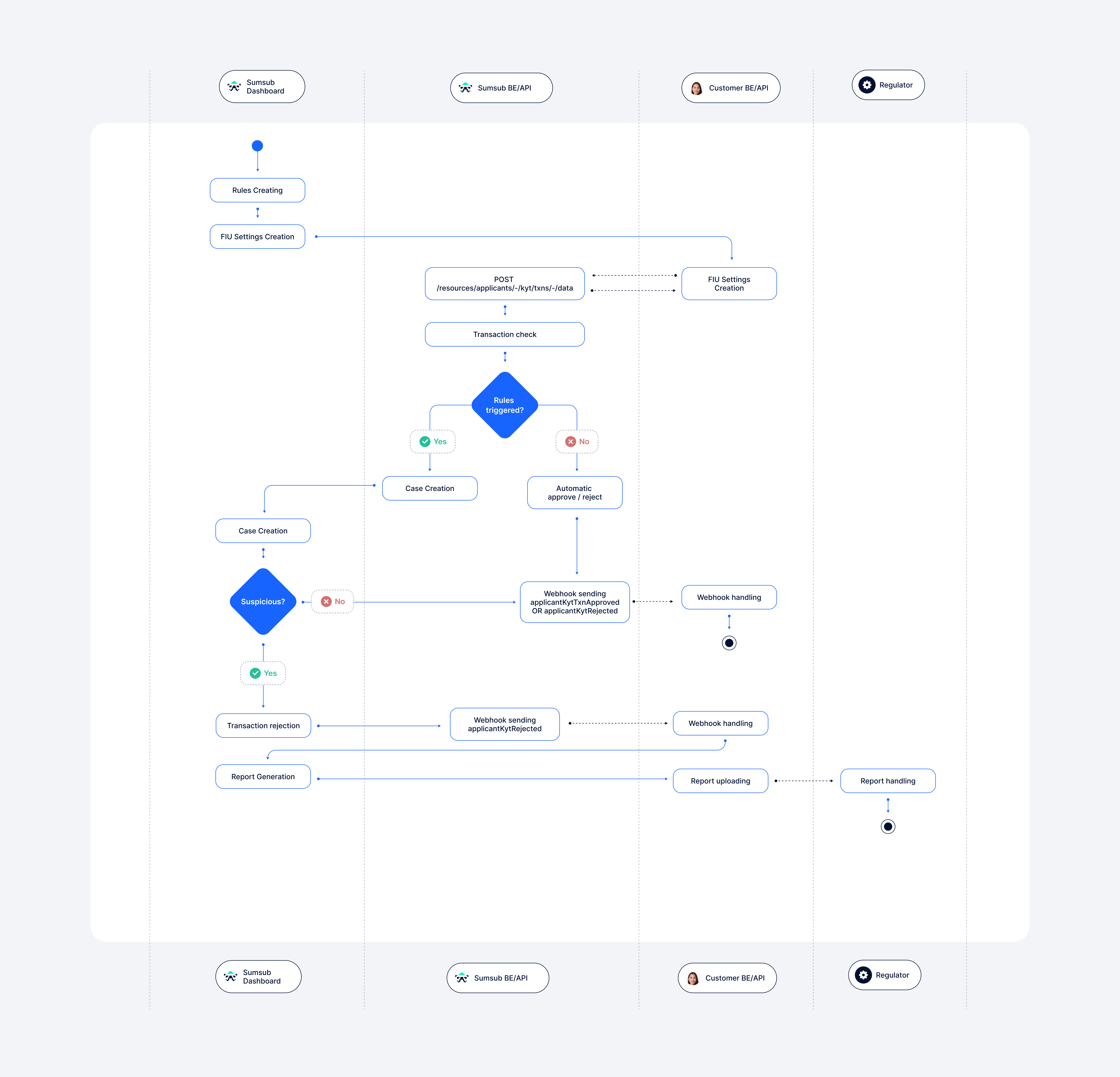
The scheme below explains the case processing flow:
Available jurisdictions
Currently, you can generate reports for 50 countries worldwide:
Soon, the list will be expanded to include new locations and formats.
Available report types
Available report types depend on transaction counterparties and include the following:
- My client to My client
- My client to Third party
- Third party to My client
Generate reports using report template builder
Report Builder allows you to generate reports for Financial Intelligence Units (FIUs) and save them as templates, eliminating duplicate data entry for future filings.
To create a report template, navigate to the appropriate settings page depending on your workspace version:
- Case Management 1.0: Go to the Reports page.
- Case Management 2.0: Go to the FIU Report Templates page.
- Click Create Report Template and select the jurisdiction and report type.
- Use the sidebar checkboxes to select the fields you want to include in the report.
-
Required Fields: Some fields are mandatory and cannot be excluded. These contain static information that will be automatically validated before the report is generated.
-
Optional Fields: Non-mandatory fields allow you to map any transaction field from the goAML schema into your report. For example, you can enrich the mandatory transaction data with more detailed information about the involved parties and currencies.
-
- Click Finalize report template.
The table below contains a brief description of all available fields.
| Field | Obligatory | Description | Input |
|---|---|---|---|
| Rentity ID | Yes | A unique identifier assigned to the reporting entity. It helps the FIU track and manage reports from various entities. | Text |
| Rentity branch | No | The location of the branch of the reporting entity that is submitting the report. | Text |
| Submission code | Yes | The code that identifies the type of report being submitted. It lets the FIU categorize the submissions for processing. | Drop-down list |
| Report code | Yes | The code that categorizes the nature of the report, such as money laundering, terrorist financing, or other suspicious activities. | Drop-down list |
| Entity reference | No | A reference number or code assigned by the reporting entity for internal tracking purposes. | Number |
| FIU reference number | No | The reference number of the Financial Intelligence Unit that processes the report. | Number |
| Submission date | Yes | The date when the report was submitted to the FIU. | Automated generation |
| Currency code local | Yes | The code representing the currency of the reported transaction or activity. | Drop-down list |
| Reporting person | No | The individual who is responsible for submitting the report on behalf of the reporting entity. | Drop-down list |
| Location | No | The geographical location where the transaction or suspicious activity occurred. | Text |
| Reason | No | A brief explanation of why the transaction or activity was considered suspicious. | Text |
| Action | Yes | Actions taken by the reporting entity in response to the suspicious activity, such as freezing accounts, conducting internal investigations, or filing additional reports. | Text |
| Transactions | Yes | The specific transaction data to be added to the report, including amounts, dates, parties involved, and any relevant transaction identifiers. | Drop-down list |
| Activity | No | Activities related to the reported transaction(s), which may include patterns of behavior, previous transactions, or other contextual information that can assist in analysis. | Automated generation |
| Report indicators | No | Transaction or activity indicators that help in assessing the level of risk associated with the issue. | Drop-down list |
NoteYou must collect most information only once per regulation, as it will be saved for further reports.
To use your saved templates:
- Navigate to your cases list.
- Select a case, and click Generate report at the upper right corner of the screen.
- Ensure the jurisdiction, the type of the report, and the submission date are correct, and click Generate report again.
- The report file will be automatically downloaded to your computer and saved both in the Generated Reports section of the selected case and in the FIU reports tab.
- Deliver reports to the regulator by uploading them via the regulatory portal in a few clicks—they are structured in accordance with the FIU’s requirements.
You can also enable automated generation of the reports when setting up a blueprint for managing selected cases.
To do so, activate the Reporting toggle and select the STR Reports box.
Updated 2 months ago